
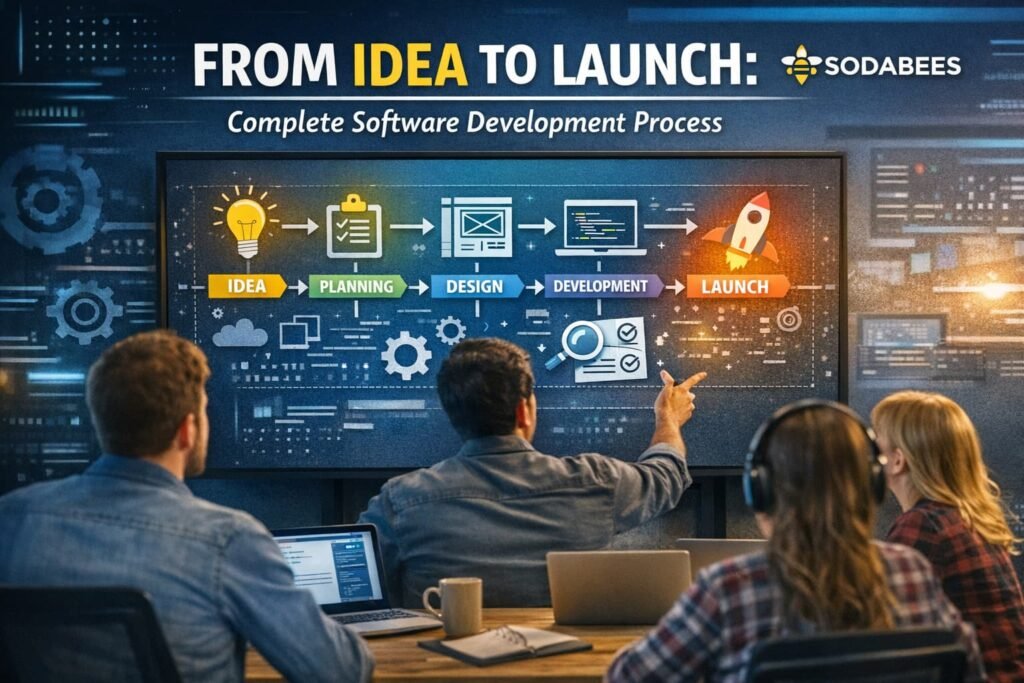
In today’s fast-moving digital world, almost every successful business idea has one thing in common: software behind it. Whether it’s a mobile app, a web platform, or a custom business system, software turns ideas into real, usable solutions.
At Sodabees, we help startups and growing businesses turn ideas into scalable, high-performance software products. As a professional software house, we follow a clear, structured development process that minimizes risk and maximizes results.
But here’s the thing — many people think software development is just about writing code. In reality, it’s a step-by-step journey that starts with an idea and ends with a fully launched product that real users love.
In this guide, we’ll walk through the complete software development process, explained in simple, human language — the same way the Sodabees team explains it to our clients.
1. Idea & Problem Identification
Every successful software product starts with a problem.
It could be:
- A business process that wastes time
- A service that customers find frustrating
- A gap in the market no one is addressing properly
At this stage, the goal is not to build software it’s to understand the problem clearly.
Good questions to ask:
- Who is facing this problem?
- How are they solving it right now?
- Why is the current solution not good enough?
Strong software ideas are usually born from real pain points, not random inspiration.
2. Market Research & Validation
Once the idea feels solid, the next step is validation.
This is where many projects fail not because the software is bad, but because no one actually needs it.
Market research helps answer:
- Are people already using similar solutions?
- Who are the competitors?
- What do users like or dislike about existing products?
Validation doesn’t have to be expensive. It can include:
- Talking to potential users
- Online surveys
- Studying competitor reviews
If the market response is positive, you’re ready to move forward with confidence.
3. Defining Requirements & Scope
This stage is all about clarity.
Before a single line of code is written, the software house and the client must agree on:
- What features will be included
- What the software will NOT include
- Timeline and budget expectations
This is usually documented in a Software Requirement Specification (SRS) or a feature list.
Clear requirements help avoid:
- Scope creep
- Budget overruns
- Misunderstandings later
A well‑defined scope saves both time and money.
4. Planning & Strategy
At Sodabees, planning is where ideas turn into a clear roadmap. We select the right technology stack, define milestones, and create a strategy aligned with business goals and future growth.
At this stage, the development team decides:
- Technology stack (frontend, backend, database)
- Development approach (Agile, Scrum, Waterfall)
- Milestones and deadlines
Planning ensures that the project moves forward in an organized way instead of chaos.
For startups, this phase often includes building an MVP (Minimum Viable Product) a basic version of the software with only essential features.
5. UI/UX Design
Design is not just about making things look pretty it’s about how users feel and interact with your software.
UI (User Interface) focuses on:
- Layout
- Colors
- Typography
UX (User Experience) focuses on:
- Ease of use
- Navigation flow
- User satisfaction
Good design:
- Reduces confusion
- Improves engagement
- Increases conversions
Design prototypes are often shared with clients before development starts, so feedback can be incorporated early.
6. Software Development (Coding Phase)
This is where the Sodabees development team brings designs and ideas to life through clean, secure, and scalable code.
Developers write clean, secure, and scalable code based on approved designs and requirements.
Development usually happens in stages:
- Frontend development (what users see)
- Backend development (logic, database, servers)
- API integrations
Modern software houses follow Agile development, meaning features are built, tested, and improved continuously.
7. Testing & Quality Assurance
No software should ever be launched without testing.
Testing ensures that:
- The software works as expected
- Bugs are identified and fixed
- Performance is stable
- Security vulnerabilities are minimized
Types of testing include:
- Functional testing
- Performance testing
- Security testing
- User acceptance testing (UAT)
This phase protects your brand reputation and user trust.
8. Deployment & Launch
Once testing is complete, the software is ready to go live.
Deployment includes:
- Server setup
- App store submission (for mobile apps)
- Domain and hosting configuration
A successful launch is usually planned carefully to avoid downtime or technical issues.
Many software houses prefer soft launches releasing the product to a limited audience first, then scaling gradually.
9. Post‑Launch Support & Maintenance
At Sodabees, launching the software is only the beginning. We provide ongoing support, performance monitoring, security updates, and continuous improvements to ensure long-term success.
After launch, real users start using the product, and this leads to:
- Feedback
- Bug reports
- Feature requests
Ongoing maintenance includes:
- Performance optimization
- Security updates
- Feature improvements
Software that is regularly updated stays competitive and reliable.
10. Scaling & Future Growth
Once the product gains traction, it’s time to scale.
Scaling may involve:
- Adding new features
- Improving infrastructure
- Supporting more users
A well‑built software system can grow with your business instead of holding it back.
Final Thoughts
At Sodabees, we believe successful software is built through collaboration, transparency, and continuous improvement.
From idea validation to final launch and beyond, our team works closely with clients to deliver reliable, future-ready software solutions.
Whether you are a startup or an established business, Sodabees is your trusted partner for custom software development.